Customers Do Not Buy Benefits. They Buy Value.
Many salespeople know their products extremely well. They can explain specifications, capabilities, options, processes, and technical details with confidence. The problem is that customers rarely buy any of those things by themselves.
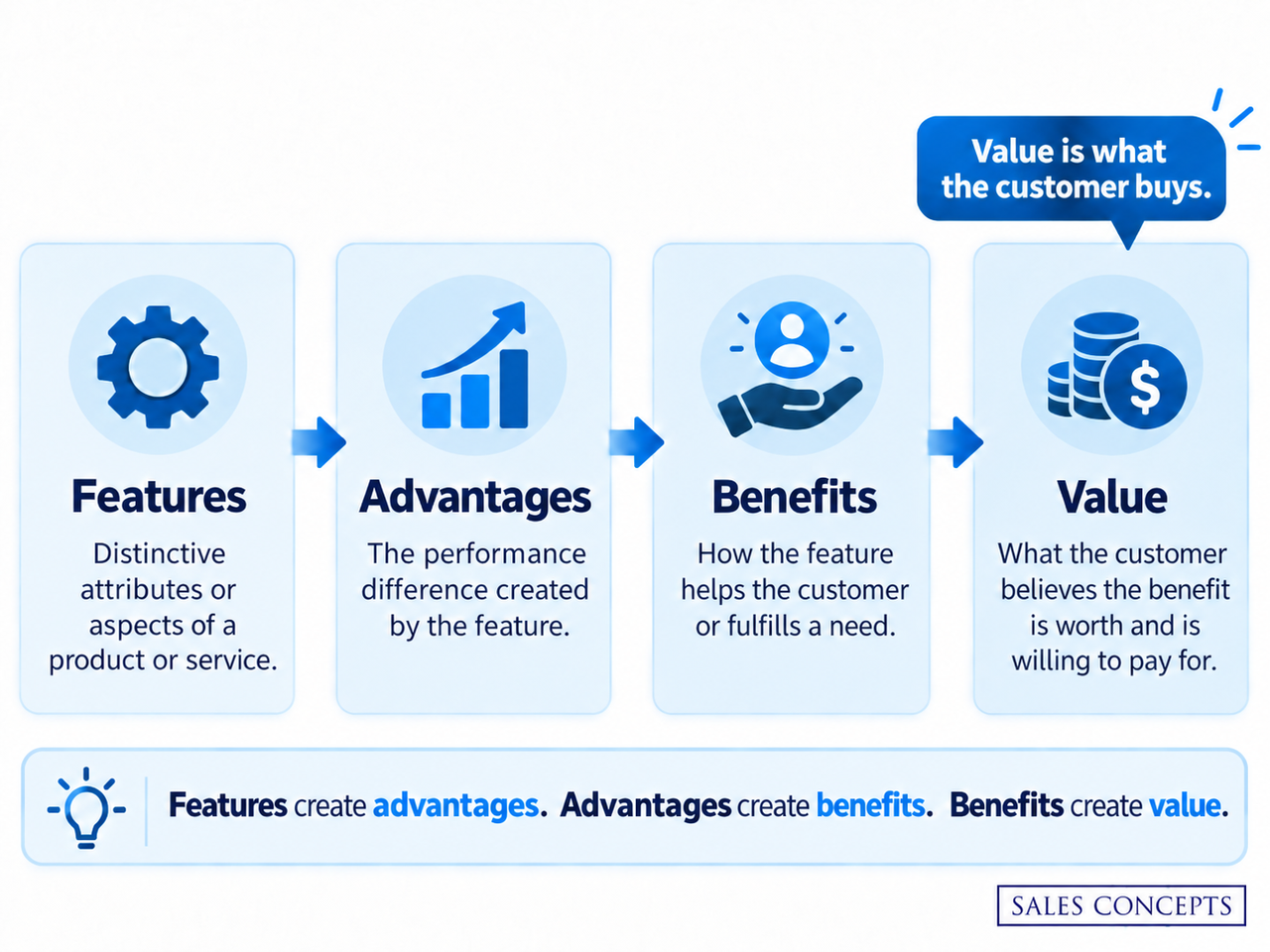
Features are distinctive attributes or aspects of a product or service. They describe what something is, what it includes, or how it is designed. A faster processor, a longer warranty, a specialized coating, an automated reporting function, or a dedicated support team are all features.
Features matter because they can create advantages.
An advantage is the performance difference a feature creates. A faster processor may reduce processing time. A specialized coating may increase product life. Automated reporting may reduce manual work. Dedicated support may speed problem resolution. The advantage answers a different question: What does this feature allow the product or service to do better, faster, safer, easier, or more reliably?
Advantages matter because they can create benefits.
A benefit is what the advantage does for the customer. Reduced processing time may increase production capacity. Longer product life may reduce replacement frequency. Less manual work may free employees to focus on higher-value tasks. Faster problem resolution may reduce downtime or improve productivity.
This is where sales conversations often improve dramatically. Benefits connect performance to customer needs, priorities, problems, and goals.
But benefits still do not determine whether a customer will buy.
Value is what the customer believes the benefit is worth. It is the economic, operational, strategic, or personal importance the customer attaches to the result. It is also what determines whether the customer is willing to pay for it.
Features create advantages. Advantages create benefits. Benefits create value. Value is what the customer buys.
That means salespeople should spend less time explaining everything a product can do and more time identifying what matters to the customer.
Value-identifying questions become critical. What happens if this problem continues? What does the current process cost? How much time is being lost? What is the impact of downtime, delays, errors, scrap, rework, turnover, lost capacity, or missed opportunities? What would improve if this issue disappeared? What would that improvement be worth?
These questions do more than quantify obvious benefits. They help customers recognize value they may not have considered.
A customer may know that a new system saves labor, but may not have calculated the additional production capacity that labor savings creates. A buyer may understand that better reliability reduces downtime, but may not have considered the effect on customer retention, overtime, or delivery performance.
That unrealized value can change the entire sales conversation.
When salespeople uncover it, price becomes easier to justify because the customer has a clearer picture of what the investment produces.
Until that value is clear, even an excellent solution can look expensive, unnecessary, or interchangeable.
Do not stop at the feature. Do not stop at the advantage. Do not even stop at the benefit. Keep asking questions until the customer can see, measure, and believe the value. That is where favorable buying decisions are made.