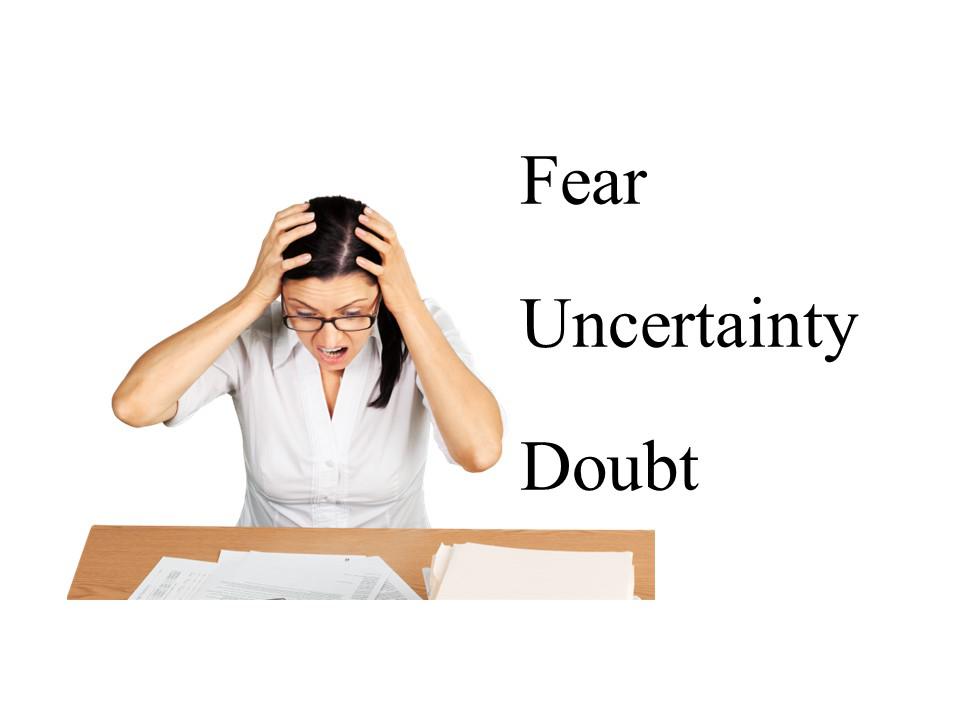
Fear, Uncertainty, and Doubt: The Hidden Barriers to a Sale
Most salespeople spend a lot of time trying to prove their solution is the right choice for their customers. They explain capabilities, demonstrate value, answer objections, and build business cases. Yet many sales opportunities stall for reasons that have little to do with features, price, or even competition.
The customer is afraid!
That fear may not be obvious. In fact, the customer may not even be fully aware of it. Buying decisions usually create risk. A new supplier could fail. A new system could disrupt operations. A major investment could disappoint senior management. A process change could frustrate employees. A champion could lose credibility if things go badly.
These concerns create fear, uncertainty, and doubt. When they remain unspoken, they can quietly slow the sales process, create delays, increase requests for more information, and lead customers to choose the safest option: doing nothing.
Many salespeople make the mistake of waiting for the customer to raise these concerns.
Strong salespeople seek out and identify risk before it becomes an objection.
That requires insightful questions.
Instead of asking only about needs, goals, and budgets, salespeople should ask questions that uncover what could make the customer uncomfortable about moving forward.
For example:
- What concerns would you have about making this change?
- What could go wrong from your perspective?
- Who inside your organization might be uncomfortable with this decision?
- If this solution did not produce the expected result, what would the consequences be?
- What has caused similar projects to struggle in the past?
- What would have to be true for you to feel confident moving forward?
These questions help customers think about risk in a structured way. More importantly, they allow you to address concerns before they become reasons to delay the decision.
Some risks will be obvious. Others may emerge only through conversation. A customer may initially say that everything looks good, yet deeper questions reveal concerns about implementation, internal politics, employee resistance, switching costs, technical integration, or personal accountability.
You should not try to eliminate every possible risk. That is rarely realistic. The goal is to identify the risks that matter most and reduce the uncertainty surrounding them. Many times the impact of a risk is greatly reduced by simply acknowledging it!
That may involve providing references, outlining an implementation plan, offering a pilot, clarifying responsibilities, establishing performance measures, or discussing contingency plans.
Customers rarely make important decisions based only on potential gain. They also consider what they could lose.
If salespeople focus only on value, they may miss the invisible forces slowing the decision.
A better approach is to help customers identify risks they may not have fully considered, discuss those risks openly, and create a clear plan to manage them.
When you anticipate potential problems and discuss them openly, customer confidence increases. The decision becomes less about leaping and more about making a thoughtful, manageable, sound business choice.
Sometimes the biggest competitor is not another supplier. It is the uncertainty about what happens after they say yes. People move when staying the same feels riskier than changing.