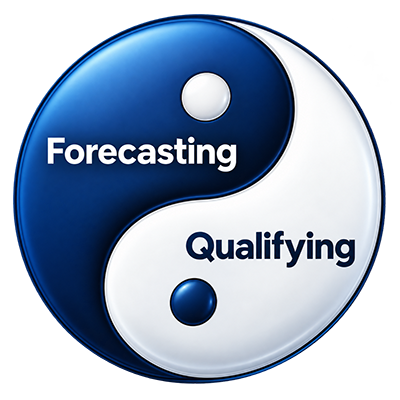
Better Forecasts Start with Better Qualifying
Many salespeople treat qualifying and forecasting as separate activities. Qualifying happens while working the opportunity. Forecasting happens when management asks for a number.
That separation creates problems.
An accurate forecast results from thorough qualifying, and thorough forecasting helps you qualify. An objective forecast can help a salesperson decide whether an opportunity deserves more time, attention, and resources.
Qualification asks important questions. Does the customer have a need? Is there money available? Who makes the decision? What is the timing? Who else is involved? What obstacles are in the way?
The problem is that salespeople often answer those questions and become optimistic. We hear positive comments, develop a good relationship, deliver a presentation, and begin believing the opportunity is further along than it really is.
Objective forecasting changes the conversation.
Consider an opportunity that a salesperson describes as 75 percent likely to close. What evidence supports 75 percent?
- Has the customer defined the problem?
- Has the customer quantified the impact of solving it?
- Have you identified the economic buyer?
- Have you spoken with that person?
- Are the technical and user influences involved?
- Has the customer agreed on decision criteria?
- Is there a defined decision process?
- Is funding approved?
- Has the customer committed to the next step and date?
These are observable events. They provide evidence. They also expose gaps. This is where forecasting becomes a qualification tool.
Suppose the opportunity is expected to close in 30 days, but you have never met the economic buyer. The answer is not to lower the forecast percentage. The missing access tells you what needs to happen next. Your next step becomes clear: gain access to the economic buyer.
If the customer sees value but has not built a financial justification, the next action may be developing a business case.
If technical approval is missing, the next action may be scheduling a technical review.
If there is no agreed-upon decision date, the next action may be determining what is driving the timeline.
Every weakness in the forecast should point toward a qualification question or sales action.
This is why objective forecasting is more valuable than assigning percentages based on instinct. A forecast should not merely predict what might happen. It should help you decide what to do next.
The best salespeople use forecasting as a diagnostic process. They look for evidence, identify what is missing, and decide whether the opportunity deserves investment.
Sometimes the right action is to advance the opportunity. Sometimes it is to slow down and gather information. Sometimes it is to disqualify the opportunity.
That is not losing a sale. It is protecting your valuable time.
Qualification tells you whether an opportunity is real. Objective forecasting tells you how real it is, what is missing, and what must happen next.
When those two disciplines work together, your pipeline becomes more accurate, and you become more effective.