I provided everything they wanted, and they will did not buy.
At one time or another, every salesperson has probably thought this after losing a deal.
Benefits alone do not sell. While it is true that people buy what they perceive as benefits, they must believe that the benefits are worthwhile. The reward must be clearly bigger than what the customer must do to get it. Four things sit on that other side of the scale, and they are easy to remember with the acronym RICE.
- Risk. Fear, uncertainty, and doubt kill more deals than price, and most of that fear is personal. Nobody wants to champion a project that fails.
- Impact. The broader the change, the larger the consequences if it goes wrong.
- Cost. The higher the cost, the higher the return needs to be to justify it.
- Effort. Staples got it right with the easy button. Customers resist complicated processes.
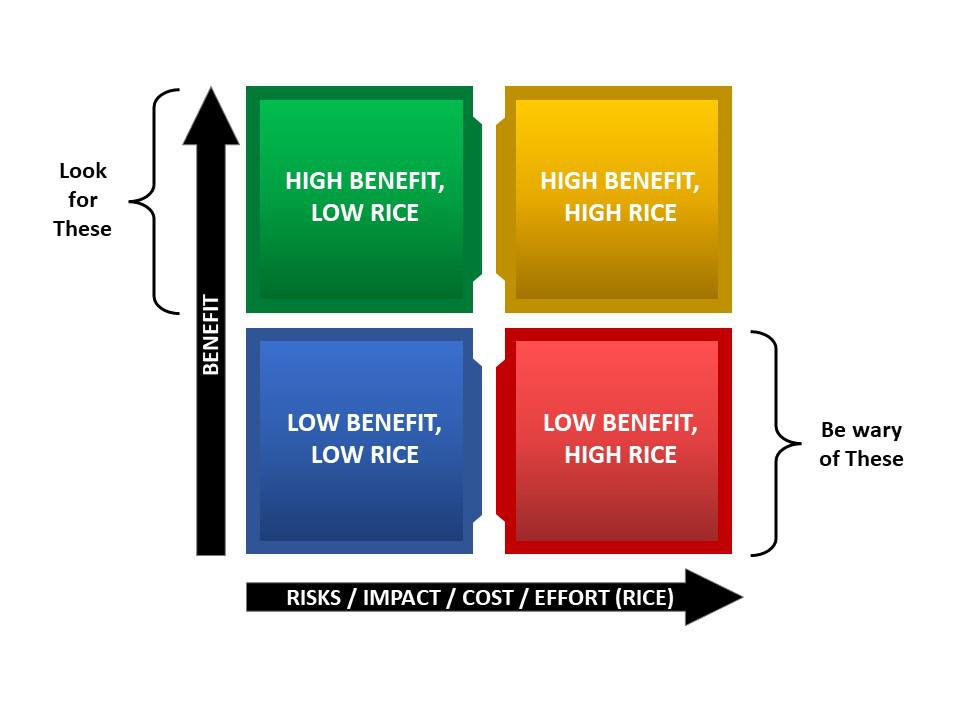
Picture a grid. Benefits range from low to high along the vertical axis (Y-axis). Risk, impact, cost, and effort range from low to high along the bottom of the grid on the X-axis. Every opportunity you have sits in one of four boxes.
High benefit and low RICE, the upper left, is where deals close quickly. The reward is obvious, and your champion can easily defend it.
High benefit and high RICE, the upper right, is winnable and usually where the larger deals are on your list, but they need a consensus, a business case, a pilot, a reference, or a phased start before anyone commits.
Low benefit and low RICE, the lower left, is easy to approve and just as easy to postpone forever.
Low benefit and high RICE is the least desirable place to invest your time.
Your real competition is often the customer doing nothing or postponing the decision. Doing nothing seldom provides any tangible benefits; however, it carries little or no risk, cost, or effort, so it sits comfortably in the lower left. That is the inertia you truly must overcome.
There are two ways to overcome this dilemma. Increase the perceived benefit or reduce the perceived RICE.
To increase the benefit, address what your solution does rather than what it is. Keep searching until you find ways to save time or increase money, comfort, and well-being.
To reduce the RICE, do the work your customer is dreading. Create an implementation plan. Name who does what and when. Offer a trial or site visit. Provide a reference who has already been through it. Show not only what changes but also what stays the same. Work to understand what your customers fear and reduce it.
Discounting does not rescue a deal that is stuck on the effort side. Price is a feature, and the lowest price is seldom the best value. Cutting the price shrinks your reward while the customer effort remains the same.
Before your next call, evaluate everything the customer must spend, risk, change, and manage to get the benefit you are promising. Then determine how you will shorten that list. Salespeople who make things easy for their customers outperform those who do not.